
Over the past few years, long-duration equities have delivered strong returns supported by falling discount rates, investor enthusiasm for growth assets, and a willingness to pay higher valuations for earnings expected further into the future. While that environment has been favourable for growth-oriented holdings, it has also left many portfolios more exposed to valuation risk and to a reversal in market leadership. This risk can lead to absolute losses over time but more likely in our view to higher volatility moving forward from this juncture.
Against that backdrop, we have made some changes to the growth component of our strategies which are designed to improve balance, broaden diversification, and reduce the potential reliance on a narrow set of return drivers.
In practical terms, replacing a long-duration global growth trust holding and a specialist Asian income fund holding with a broad-based emerging markets dividend ETF and an actively managed UK equity fund changes the shape of our strategies at the margin. Of the two funds that have been replaced, the growth trust holding has historically provided significant exposure to long-duration growth, innovation, and to businesses whose value depends heavily on future earnings, whilst the Asian income fund has added a distinct regional income sleeve. By moving away from those holdings, we reduce the portfolio’s sensitivity to expensive growth styles and to Asia-specific income exposure that has a focus on growing dividends rather than on current payments.
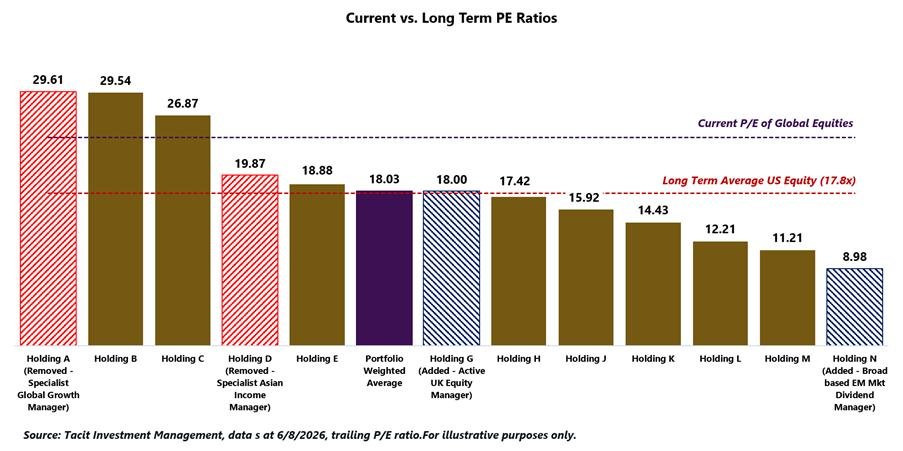
The new holdings should help shift the portfolio toward a more diversified and, in our view, more resilient equity mix. Based on their combined mandates, both are more likely to contribute broader stock selection, emphasising quality, value, and income characteristics than the concentrated growth exposure we are stepping away from. That does not mean reducing ambition, rather, it means improving the balance between growth potential and valuation discipline. The chart above illustrates the lower average PE ratios across the holding in the two new replacement funds (hatched blue) compared with the two funds which have been sold down (hatched red).
We believe this matters because investment outcomes are shaped not only by what a business can achieve, but also by the price paid for that future growth. After a strong run from long-duration equities, valuations become increasingly important. When expectations are high, the scope for disappointment rises, and even the best companies can struggle to deliver attractive returns if investors have already priced in too much good news.
Our objective is to remain invested in equities while avoiding unnecessary concentration in one style or region. These changes reflect a clear preference for diversification, disciplined risk-taking, and a portfolio that we believe is better positioned for the next phase of the market cycle following a period of extremely strong strategy returns (*).
(*) As with any change of this kind, it is not without risk. The emerging markets dividend ETF carries additional currency, political and liquidity risks associated with developing markets, and its dividend-screening approach may narrow the pool of eligible holdings, resulting in different sector and country weightings than a broader emerging markets index. The UK equity fund increases the portfolio’s concentration in a single market, which may behave differently to global equities over the short term and carries the specific economic and currency risks associated with the UK sectors it holds.