
Interest rates have dominated the financial headlines recently, but a look at long-term data suggests we are witnessing a return to “normal” rather than a move toward an extreme. For many investors, the current environment feels like a radical departure, yet historical benchmarks indicate that the era of zero and negative rates was the true anomaly.
Experiences drive behaviour and in our view many investors have not experienced interest rates above inflation before in their careers.
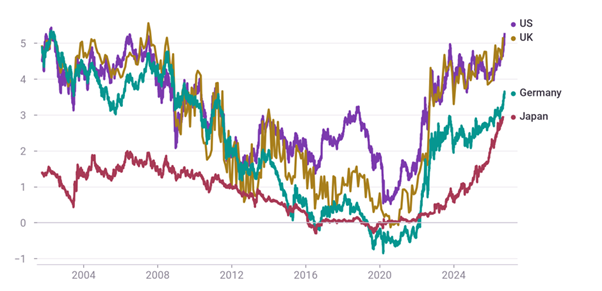
The period of ultra-low rates that followed the 2008 Global Financial Crisis was an historical exception driven by artificial policy interventions rather than sustainable growth. In fact, zero interest rate policies (ZIRP) were in place for 9 of the last 19 years in the U.S. This created a massive, yet temporary, supply of cheap capital; between 2017 and 2021 alone, over $30 trillion in bonds were issued at near-zero coupons.
Outside the U.S., the anomaly was even more pronounced. Eurozone borrowing costs remained below 1% for over a decade starting in 2009, even dipping into negative territory between 2015 and 2022. Japan went further still, operating with policy rates at or close to zero for much of the period from the late 1990s onwards.
Today’s yields are actually aligning closely with long-term historical medians. Rather than a “reckoning,” analysts view the current 5% range for U.S. Treasuries as a structural normalization.
Source: Tacit Investment Management, Macrobond
The shift away from the “monetary dominance” of the post-2008 era is being replaced by a more balanced environment of fiscal activism and higher through-cycle interest rates. While the transition has caused volatility, with U.S. 10-year yields recently trading above 5.2%, this correction likely reflects a healthier long-term growth trajectory.
Investors are encouraged to view today’s rates not as a high-rate outlier, but as a restoration of the bond market’s traditional role in a growing economy. This “structural normalization” marks a definitive exit from the era of cheap capital, signalling a return to the levels of bond yields last seen before the global financial crisis.
At Tacit, we see a ‘real’ positive cost of capital as a good thing in the longer term. For us, that means risk assets must offer a sufficiently attractive prospective return above inflation to justify owning them. At present, we believe many investments continue to meet that hurdle. The key at the moment is to monitor if these ‘normal’ rates settle at current levels or continue to rise, exhibiting a concern about longer term inflation expectations. Strangely, and rather boring, is the fact that inflation expectations in the US, UK and Europe remain very well anchored.