
For the first time in six years, the UK carries as much weight in our strategies as the US. Some of you may find that surprising, given how much attention American shares have attracted in recent years. It is not a bet on the British economy. It is the result of asking the same question of every market: what are we being asked to pay for the businesses within it? Valuation is the foundation of our investment process: we seek to buy equities at prices that leave sufficient room for the underlying business, its earnings, and its prospects to reward the risks taken. We do not assume that yesterday’s winners will necessarily remain tomorrow’s best investments.
Geographic exposure should not be fixed simply because it has served a portfolio well in the past. As the relative attractions of businesses and markets change, so too may the balance of regional exposure. The question remains the same: does the price leave enough room for the investment to reward us for the risks we are taking?
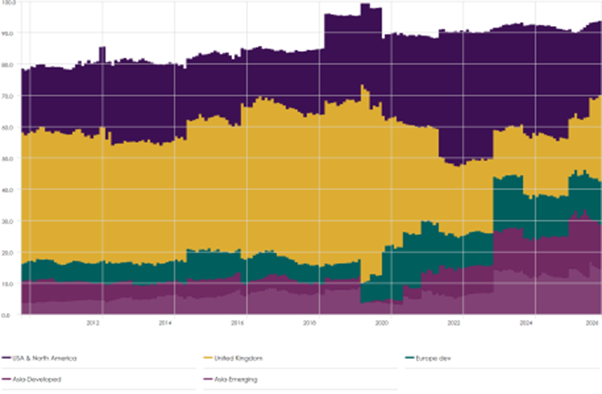
Chart: Tacit Total Return portfolio – exposure to its top five world regions (USA & North America, United Kingdom, Developed Europe, Developed Asia and Emerging Asia), as a percentage of the portfolio, 2010 to 2026. Source: Tacit Investment Management, portfolio holdings data.
The chart above shows how the regional exposure of our Total Return portfolio has shifted since 2010. Applying the same price discipline throughout, rather than tying the portfolio to any fixed country or benchmark weighting, has served clients well over the long term. Over the ten years to September 2026, our Total Return strategy ranked in the top 10% of portfolios with a similar level of risk in the ARC Private Client Indices.* The US has not been abandoned; it remains one of our two largest regions. What has changed is its price relative to what is on offer elsewhere.
A preference for one region over another is rarely a judgement that businesses elsewhere lack quality. More often, it reflects the price being asked for that quality. Buffett’s observation that price is what you pay and value is what you get applies to whole stock markets as much as to individual companies: an excellent business can still be a poor investment if the price already assumes everything goes right.
Businesses with strong growth prospects can be attractive investments, but only when their valuation leaves room for future outcomes to meet or exceed expectations. Equally, businesses in less fashionable markets may offer more compelling value when their earnings, dividends and long-term prospects are not fully reflected in the share price.
A low headline valuation is not, in itself, sufficient reason to invest. Value can mean a price that is low relative to history, but it can also mean a price that is attractive relative to a company’s future potential.
We consider the durability of earnings, the strength of a company’s balance sheet, its ability to generate cash, and the wider balance of the portfolio. A compelling valuation is most useful when it is supported by a business capable of delivering over the long term.
Regional exposure is therefore the outcome of investment selection, rather than a top-down forecast about which economy will grow fastest. A region may contain compelling opportunities at one point in time and fewer at another.
This does not mean abandoning a market because its recent performance has been disappointing, nor pursuing one simply because it has been strong. It means assessing the businesses available, the prices at which they can be bought and the balance they bring to the wider portfolio.
In practice, if you see the UK weighting in your portfolio rise, or the US weighting fall, please read it as a statement about prices rather than a forecast about economies. Should American businesses again offer better value for the risk involved, we would expect to own more of them. The regions will keep changing. The discipline will not.
*Tacit IM Total Return Strategy GBP, net of fees, versus the ARC GBP Equity Risk PCI peer group, ten years to 30 September 2026. Source: ARC Research (part of S&P Dow Jones Indices). Past performance is not a reliable indicator of future returns. The value of investments and the income from them can fall as well as rise, and you may get back less than you invested.