
Ask most people what government bonds are for and the answer will be some version of “safety”: the part of a portfolio meant to sit still while equities do the work. Rising interest rates, a long spell of inflation and a steady drumbeat of headlines about government borrowing on both sides of the Atlantic have left many investors wondering whether sovereign fixed income can be relied on at all. We think that is the wrong question. “Government bond” tells you who you are lending to; it says very little about how the investment will behave.
The chart below shows the total return, in sterling, of five types of sovereign fixed income since the start of 2022, shortly after the Bank of England began raising rates from 0.1%.
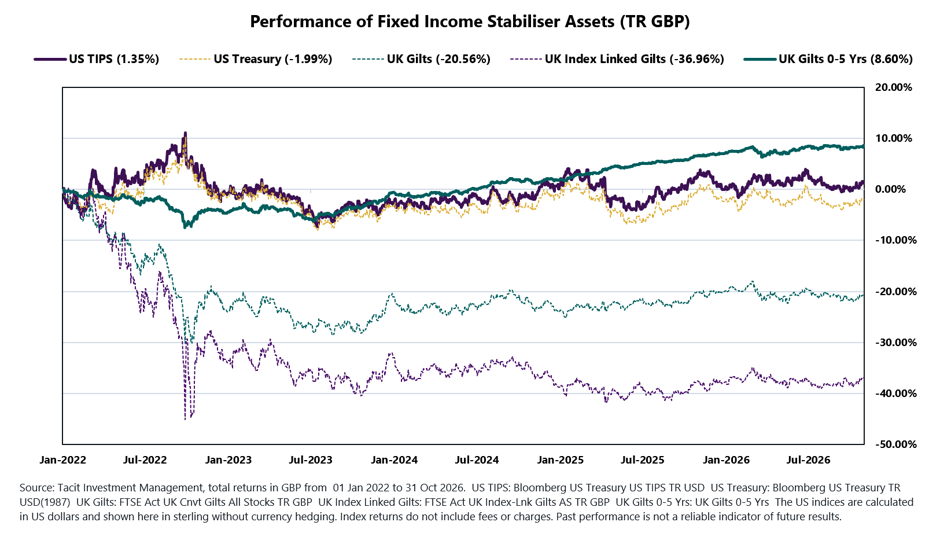
Since then, the broad gilt market has lost around 21%, while UK index-linked gilts have fallen by almost 37%. By contrast, shorter-dated gilts returned 8.6% and US Treasury Inflation-Protected Securities (TIPS), measured in sterling, returned a modest 1.35%. Calling all of these “bonds” is a little like calling a family hatchback and a racing car both “cars”. They share a basic design, but you would not expect them to handle a sharp bend in the same way.
Most of the difference comes down to duration, and how sensitive a bond’s price is to a change in yields. Think of it as the length of a lever. As a rough illustration, a bond with a duration of two years might fall by around 2% if yields rise by one percentage point, while a bond with a duration of 15 years might fall by around 15%. Shorter-dated gilts sit on a short lever, and long-dated gilts sit on a much longer one.
The same lever explains the result that surprises people most. Surely bonds linked to inflation should have done well when inflation was high? Their inflation-linked cash flows did increase. But their market price is also highly sensitive to real yields, the return investors demand above inflation, and those moved from deeply negative levels to sharply positive territory as monetary policy tightened. Because many UK index-linked gilts are very long-dated, prices fell a long way. It is possible to be protected against inflation and still suffer a heavy capital loss along the way.
This is why we have never treated sovereign fixed income as a single block to be bought wholesale. The stabilising assets in the portfolios we manage have been built from holdings with distinct jobs. Shorter-duration UK gilts provide high-quality sterling exposure with limited sensitivity to long-term rates. US TIPS respond to US real yields and inflation expectations, giving your portfolio exposure to outcomes that gilts and global equities do not fully capture. They are not a guaranteed hedge, because when rising real yields weigh on valuations across markets, TIPS and equities can fall together, and for a sterling investor the dollar is part of the return unless hedged. Our case was that they behave differently, and they have broadly held their value while much of the market around them fell sharply.
What has changed is the price of that protection. Before rates began rising, buying TIPS often meant accepting a negative real yield, in effect, accepting a small loss of buying power each year. At the start of November, ten-year TIPS offered a real yield of around 2.65%. For an investor buying at that yield and holding to maturity, it represents an expected annualised return of roughly 2.65% above US inflation, before costs, taxes and, for a UK investor, currency effects. A holding that once charged investors for inflation protection now pays them a meaningful real yield to own it.
The same is true more broadly, with ten-year US Treasury and UK gilt yields both around and above 5%. Take a bond portfolio yielding 5% with a duration of eight years. If yields fall by one percentage point over a year, a price gain of around 8% comes on top of the income. If they rise by one point, a loss of around 8% is partly offset by it. Yields would need to rise by more than about 0.6 of a percentage point in a year before the holding lost money at all. When yields were close to zero, there was almost no such cushion. A rise in yields still hurts, but income is doing real work again, and the balance of outcomes is far more favourable to the holder than it has been for many years.
That raises the question of whether longer-dated sovereign bonds now deserve a larger role among our stabilisers. They would do well if growth weakened and inflation eased and can protect against an equity downturn caused by a slowing economy rather than an inflation shock. Against that, government borrowing remains heavy, inflation has not gone away, and long-dated yields can rise even while central banks are cutting. An attractive yield is not necessarily adequate compensation for a longer lever.
The headlines have been real, but the damage has been concentrated in particular kinds of bond rather than in sovereign fixed income as a whole, and the stabilising assets in your portfolio were chosen to avoid exactly that kind of harm. For the first time in a decade, though, the market is offering a genuine opportunity to lock in attractive real yields, and potentially to take on a measured amount of additional duration where the yield clearly pays for the risk. We are looking at that carefully.