
The UK’s relationship with property runs deep. For most households, the family home has been not merely a place to live but a source of accumulated wealth, a reliable store of value, and quietly, a point of considerable personal pride. That attachment is understandable. Over the decades, nominal house prices have risen substantially, and for many people the figures tell a straightforward story of growing prosperity.
The difficulty is that the figures can mislead. When we adjust UK house prices for inflation, stripping out the general rise in the price level to look at what property has actually delivered in real terms, a more complicated picture emerges.
In nominal terms, house prices have risen considerably over the past fifty years. In real terms, they peaked in 2007 and have not recovered that level since. That is a fact worth sitting with for a moment.
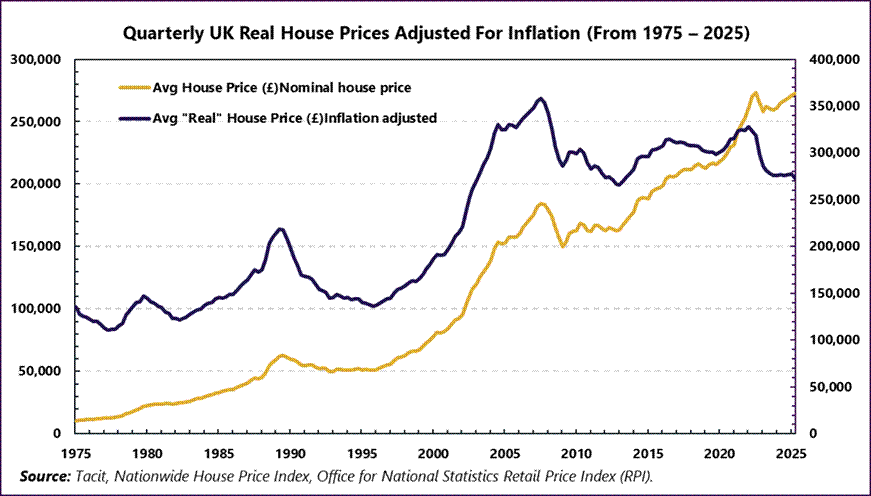
This is not, we should be clear, an argument that property is a poor asset. A primary residence does something no financial instrument can fully replicate. It removes the cost of rent, provides security of tenure, and gives a family a stable foundation. Those benefits are real and ought not to be dismissed. The question we are more interested in is a narrower one: how property performs as an investment, set against other assets over the longer run, and in particular against equities.
Property is, in the economists’ phrase, a real asset. Its value is ultimately anchored in the cost of shelter, land, labour, materials, and rents, each of which can typically be adjusted to reflect the general price level over time. On that basis, property ought to offer some protection against inflation, and historically it has. The challenge is that this protection is conditional. It depends on the level of interest rates, the availability of mortgage credit, the planning environment, and the income growth of potential buyers. When those conditions shift, as they did sharply after 2007, real returns can stagnate or reverse.
Equities work differently. A share is a claim on real corporate profits, on the earnings of businesses that can raise prices, manage costs and adapt to changing conditions. Over time, dividends and earnings growth have tended to outpace inflation more consistently than property returns. UK data across twenty-year windows since the late 1980s show that total returns from UK Equities have beaten inflation in every such period, not because nominal prices have always looked impressive, but because reinvested dividends compound significantly over time.
From a portfolio perspective, we regard equities as the cleaner inflation hedge of the two. The return stream is more consistent over long horizons, the asset is globally diversified, reducing dependence on the particular conditions of any one market, and it avoids the practical complications that property increasingly brings, namely, illiquidity, concentrated exposure, and a UK tax environment that has become progressively less favourable to property ownership outside the primary residence.
The case for property is not without merit, and we would not wish to overstate our conclusion. For most households, the family home remains an entirely sensible financial decision, partly for the reasons already given, and partly because the discipline of a mortgage provides a form of long-term saving that many people find easier to maintain than accumulating a portfolio. Those are real advantages.
What we are more sceptical about is the widespread assumption that rising house prices represent genuine wealth creation. When prices rise broadly in line with inflation, homeowners are not wealthier in any real sense, they are holding an asset that has retained its value, which is a different and more modest thing. The illusion comes from the nominal figures, which feel like gains but often are not.
On balance, the data suggest that investors with a genuine long-term horizon, seeking to preserve and grow real wealth, are likely to find equities a more reliable vehicle than residential property. That is the practical conclusion, as we see it, not an argument against owning a home, but a prompt to think clearly about what a home does and does not deliver as a financial asset.